
Tode Rekishi Kenkyukai
Tode (唐手) is the old Okinawan name for Karate. It literally translates as China Hand or Tang Hand (referring to the Tang dynasty). It is an Okinawan, rather than mainland Japanese, term developed to describe imported Chinese fighting techniques.
Rekishi (歴史) means History and Kenkyukai (研究会) means Research or Study Group.
Tode Rekishi Kenkyukai therefore can be translated as Karate (China Hand) Historical Research Group.
The name is a direct reference to The Ryukyu Tote Kenkyukai (or Tode-jutsu Kenkyukai), which was an informal, but highly significant, gathering of Okinawan karate pioneers during the Taisho era (1912-1926).
The Ryukyu Tote Kenkyukai was originally founded in 1918 in Naha by Miyagi Chojun (1888-1953) and Mabuni Kenwa (1889-1952) and was based in Mabuni’s home. By 1926, it had become a large, full-time association with its own training facility located in the Wakakusa district of Naha.
Those included in this group included Funakoshi Gichin—who was made the president, Mabuni Kenwa, Miyagi Chojun, Chomo Hanashiro, Chotoku Kyan, Nakasone Genwa, Chojun Miyagi, Kenwa Mabuni, Chojo Oshiro, Maeshiro Choryo, Kentsu Yabu, Juhatsu Kyoda, Moden Yabiku, Chibana Choshin and Wu Xiangui (the Chinese tea merchant Go Kenki) and a number of other famous Tode teachers.
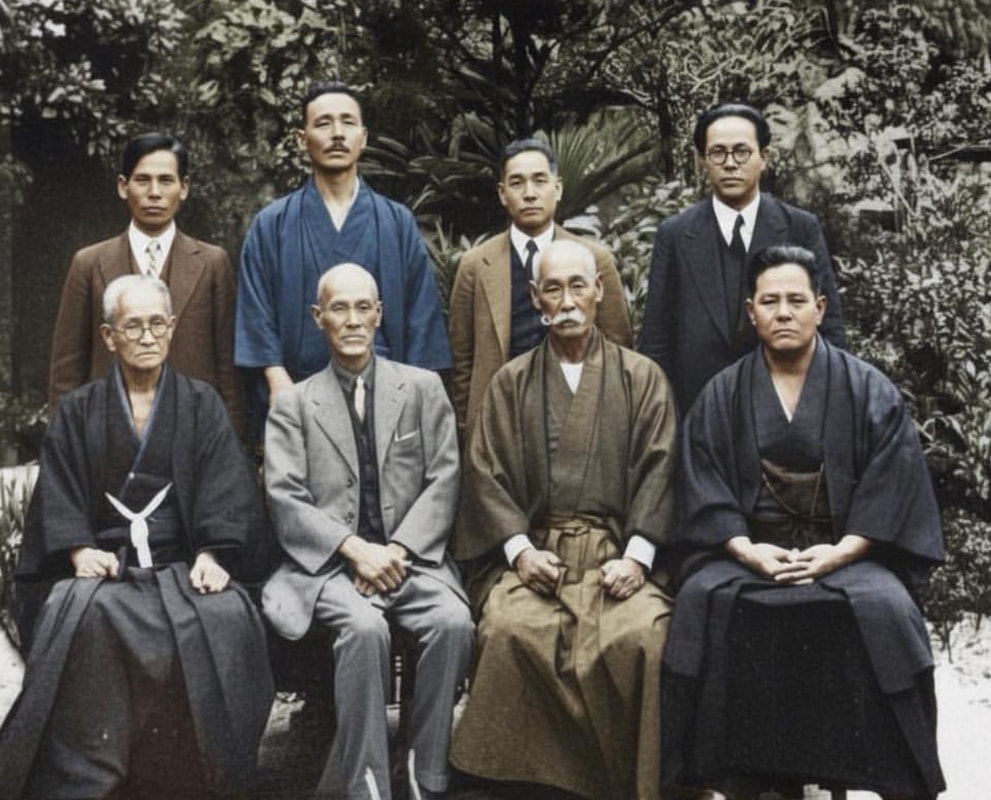
Featured in the front row are masters Chotoku Kyan, Kentsu Yabu, Chomo Hanashiro and Chojun Miyagi.
Featured in the back row are Shinpan Shiroma, Chotoku Maeshiro, Choshin Chibana and Genwa Nakasone.
Originally the organisation was meant to continue the teachings of Itosu Anko, Higashionna Kanryo and Aragaki Seisho, the last generation of masters who had died between 1915 and 1918, leaving a great void.
This group was ground breaking as it was the first time that practitioners of different “Te” systems (Shuri-te, Naha-te, and Tomari-te) cross-trained and exchanged techniques and ideas together. They met in a garden setting where each session was led by a different teacher focusing on their specific method. The Kenkyukai disbanded in 1927.
The function of the group was the research and preservation of the original China Hand system which was already disappearing with the development of Karate as it became openly taught to members of the public.
What secrets were lost we’ll never know. However, with the rapid development of Karate as a sport, many of these old methods, or what remains of them, are in danger of disappearing completely leaving very little reference to their origins.
The Tode Rekishi Kenkyukai (The Karate Historical Research Group) has been formed with similar objectives, to continue that long history of the research and preservation of karate as a martial art.
The Tode Historical Research Study Group is an open group dedicated to the research, study, preservation and teaching of karate, primarily through the study of kata and application.
The group is based in Scotland and sessions largely functions through open seminars and welcomes anyone interested in studying karate as it was originally intended, as a highly effective fighting art.
Whether you’re interested in joining a study session, attending a seminar, or contributing your knowledge to our research, we’d love to hear from you.
All current seminars are featured in our Events page and shared through our social media feeds.